
Music, memory, and a small collection of printed souvenirs from Portland’s annual celebration of sound.
Every city has its own soundtrack.
Portland, Maine, has more than its fair share. It spills out of music venues and basement practice rooms, drifts through open windows, emerges unexpectedly from barrooms and street corners, and occasionally makes an appearance in the middle of a public park on a perfectly ordinary afternoon.
But for a number of years, June 21 was something different.
It was the day we decided to turn up the volume on the whole city.
Beginning in 2013, Make Music Portland brought the international Make Music Day celebration to the streets, parks, venues, and gathering places of Maine’s largest city. Musicians of all kinds were invited to perform, audiences were encouraged to wander and discover, and anyone interested in making a little noise was welcome to participate.
The idea was borrowed from France, where the Fête de la Musique began in 1982 with a wonderfully democratic proposition: music ought not be confined to concert halls, professional performers, or people who had purchased tickets.
Instead, for one day each year, the entire city could become a stage.
A professional musician could play alongside an enthusiastic amateur. A group of strangers could become a drum circle. Someone who had never touched a harmonica could learn a few notes, while a band might find itself performing for an audience of people who had been on their way to lunch.
The important thing wasn’t perfection.
It was participation.
A city briefly transformed
Make Music Portland embraced that same philosophy.
Over the years, the celebration brought free concerts, lessons, workshops, and spontaneous musical encounters to places throughout the city. Familiar downtown spaces became performance venues. Public parks filled with performers and listeners. People encountered instruments they had never played, music they had never heard, and neighbors whose talents they might otherwise never have discovered.
The festival was as much about the character of Portland as it was about music.
Our city has always enjoyed a certain creative unruliness. Musicians, writers, artists, craftspeople, and assorted eccentrics have helped make it the place it is, often without much institutional encouragement or financial reward.
An event built around giving these people a stage—even a temporary one—seemed like a rather good idea.
And because the concerts were free, the usual barriers between performers and audiences became a little less imposing.
You didn’t need to buy a ticket or plan an evening. You could simply walk around and find yourself in the middle of something wonderful.
The art of announcing an occasion
Of course, every good festival needs a poster.
Long before digital calendars, event feeds, and social media announcements, the printed poster was one of the most direct ways to get people to turn up somewhere.
It could be beautiful, ridiculous, mysterious, or astonishingly ugly. But it had a job to do: interrupt somebody’s day long enough to make them curious about an event.
Concert posters also have a peculiar afterlife.
Originally created to announce something fleeting—a particular night, performance, or gathering—they frequently outlast the thing they were made to promote.
The music ends. The chairs are folded. The equipment gets packed away. The musicians go home.
But somewhere, a poster remains pinned to a wall.
Over time, that piece of paper becomes a souvenir, a fragment of local history, or perhaps a small work of art in its own right.
The Make Music Portland posters belong to that tradition.
Created across multiple festival seasons, they represent more than the advertising of a particular event. Each is a visual reminder of an occasion when people gathered around a shared affection for music, community, and the beginning of summer.
Together, they form a small, colorful archive of Portland’s creative life.
Back into print
Which brings us to Subletter Press.
One of the pleasures of running a small independent workshop is the opportunity to revisit good ideas, especially those that have spent too long tucked away in digital folders, old project archives, or the backs of closets.
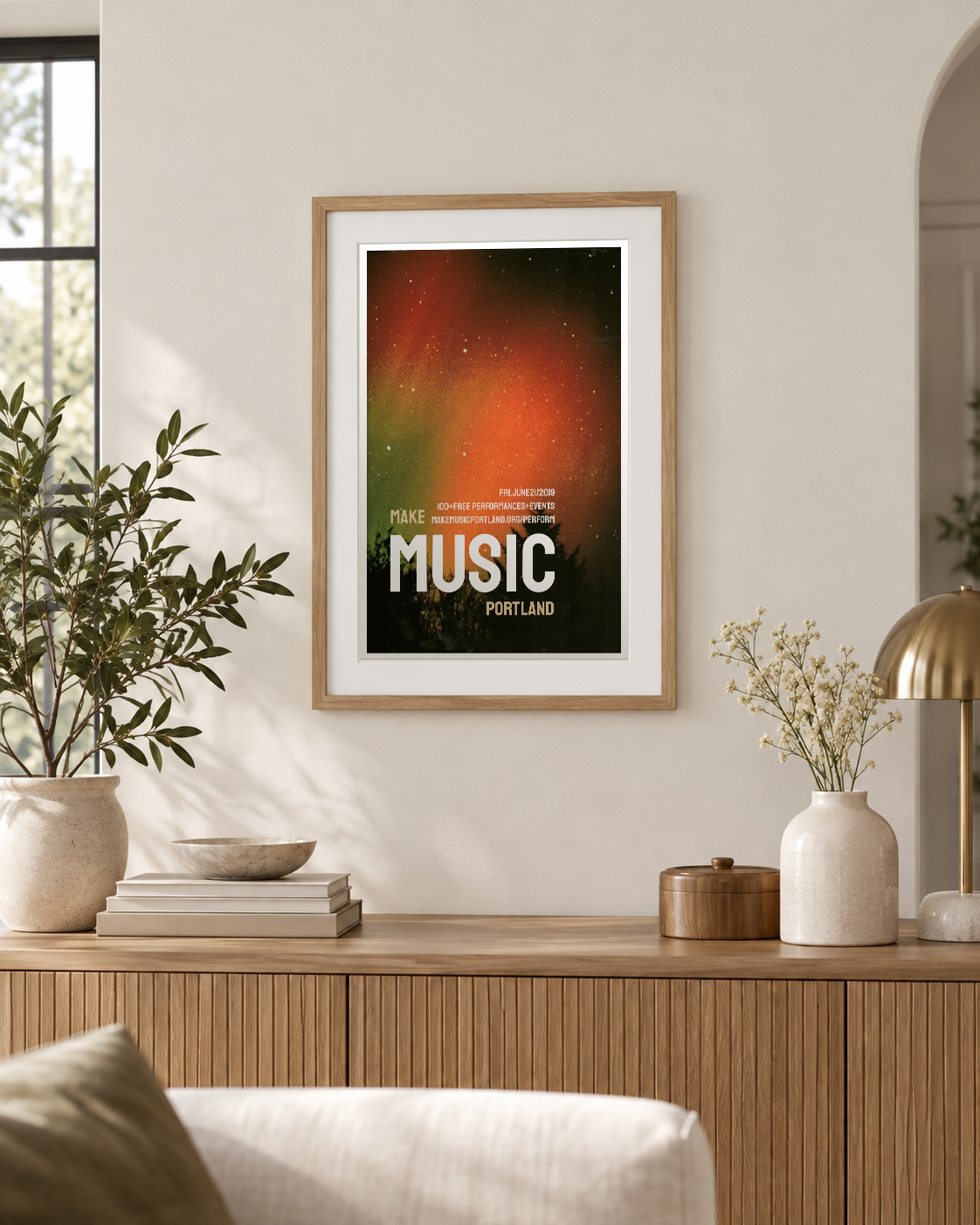
We’ve decided to give ten designs from the Make Music Portland poster collection another opportunity to find their way onto someone’s wall.
These are new, made-to-order prints of selected designs associated with more than five years of the festival, available in two sizes and with optional framing.
They’re useful decorations for a music room, studio, office, hallway, or anywhere else that could benefit from a reminder that cities are at their best when people make things together.
And because choosing just one can be unnecessarily difficult, we’re also offering a discounted collection of four.
Consider it a small, customizable exhibition of Portland’s musical past.
The next verse
Make Music Portland’s story isn’t finished.
Following a pause in 2026, the organizers are planning a return in 2027, with the same commitment to free music, public participation, and bringing the city’s creative community together.
In the meantime, these prints offer a chance to revisit some of what came before.
We’re rather fond of objects that carry a little history with them. A poster may begin its life as an announcement, but it can become something else entirely: a record of an experience, a reminder of a community, or simply a beautiful piece of paper.
We hope these designs can serve all three purposes.
The longest day of the year comes around only once every twelve months.
The posters, thankfully, can stay up all year.
Explore the Make Music Portland Poster Collection at Subletter Press. Choose from ten designs, two sizes, and framed or unframed editions—or put together a discounted set of four.